Can a small website still get visitors when Google gives answers directly on the search page? Will bloggers, creators, and small business owners lose clicks because AI search now answers many questions before readers open a website?
These are real concerns in 2026. Search no longer feels like a simple list of blue links. AI Overviews, AI Mode, chat-style answers, and answer engines now shape what people see first. That is why understanding how AI search affects small websites matters for anyone trying to grow online with limited time, budget, and authority.
Small websites do not need to panic. However, they do need a smarter content plan. AI search may reduce clicks for basic informational queries, but it can also reward clear, useful, well-structured content that solves real problems. The goal is no longer to write only for ranking. The goal is to become the source that readers and search systems can trust.
This article is written for bloggers, small business owners, and new website owners who depend on search traffic but may not have big-brand authority. The advice focuses on practical steps, current search changes, and trustworthy sources rather than fear-based SEO claims.

What AI Search Means for Small Website Owners
AI search uses artificial intelligence to collect, summarize, and present answers directly inside search results. Instead of showing only a list of pages, Google can show AI-generated answers, source links, follow-up prompts, and deeper search paths.
Google explains that AI features in Search can help people ask longer, more complex questions and explore information in new ways. For website owners, this means content may appear differently across AI Overviews, AI Mode, and traditional results. Google Search Central explains how AI features can change the way content appears in Search, which matters for small website owners.
For small sites, the change feels personal.
- A simple “what is” article may get fewer clicks.
- A strong personal guide may still attract readers.
- A clear comparison may perform better than a generic answer.
- A helpful original example may stand out when basic summaries look similar.
Why AI Search Can Reduce Website Clicks
Many readers now get quick answers without opening a page. That can hurt small websites that depend on informational traffic.
Pew Research Center found that Google users who saw an AI summary clicked traditional search results less often than users who did not see one. The study reported clicks on traditional search results in 8% of visits with an AI summary, compared with 15% without one. A Pew Research Center study found that users clicked traditional search results less often when an AI summary appeared.
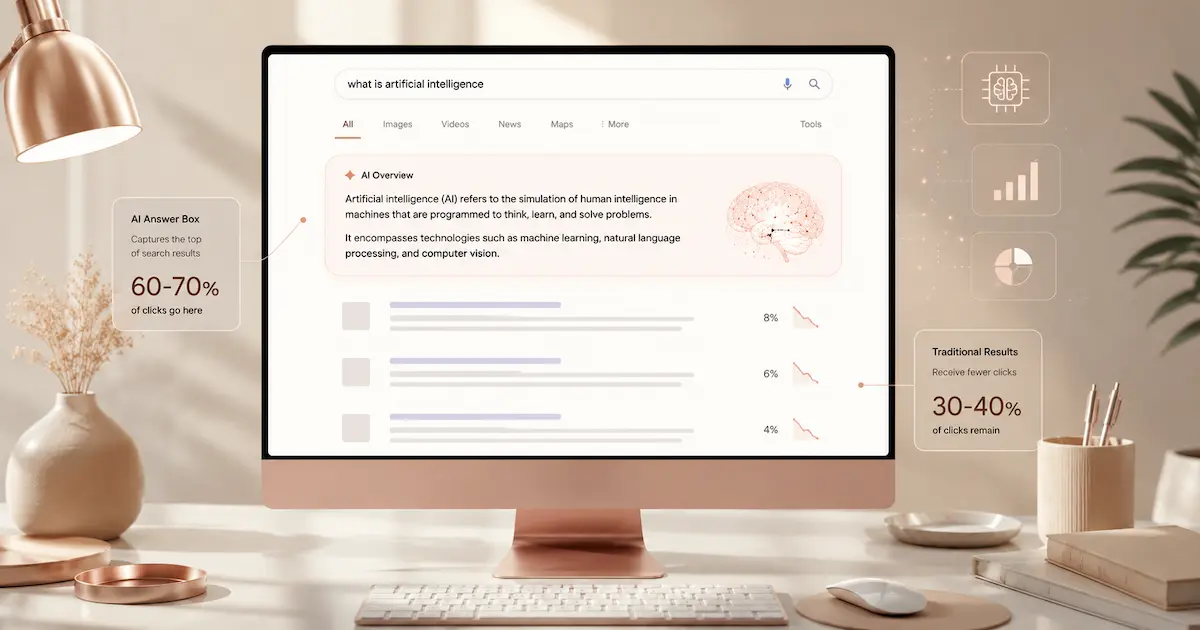
This does not mean every website will lose traffic. Still, small sites should not ignore the shift.
- Quick definitions may lose clicks first.
- Basic list posts may face stronger pressure.
- Thin articles may become easier to replace.
- Original examples may become more important.
Why Small Websites Still Have a Real Chance
Small websites can still win because AI search cannot replace every type of content. Readers still click when they want personal experience, step-by-step help, updated examples, honest comparisons, visuals, pricing context, and practical judgment.
A small website has one advantage that big sites often lose: a closer connection with readers. A beginner does not always want a corporate report. Sometimes they want a calm explanation from someone who understands confusion, budget limits, and real website struggles.
AI search is now part of everyday online visibility, so small website owners need to understand it along with SEO, content planning, and other practical digital marketing basics. Google’s helpful content guidance says pages should be created for people first, not only to attract search engine visits. This matters even more when AI summaries compete for reader attention.

- Small sites can sound more human.
- Personal experience can improve trust.
- Practical examples can hold attention.
- Reader-focused content can build loyalty.
What Small Website Owners Should Do First
- Check which posts still get impressions.
- Improve titles and introductions.
- Add original examples and screenshots.
- Link related posts together.
What Type of Content AI Search May Replace First
AI search can answer basic, repeated, surface-level questions very quickly. So, small websites that publish only common information may struggle. For example, an article that explains “what is SEO” without examples, screenshots, personal context, or action steps may not give readers enough reason to click. AI can summarize that type of topic in seconds.
However, a post that explains how a small website owner should update old content after AI Overviews, check Search Console queries, improve internal links, and rewrite weak intros has stronger value.
- Generic definitions are risky.
- Rewritten common advice may fade.
- Tool lists without testing feel weak.
- Personal workflows can add fresh value.
What Type of Content Can Still Bring Clicks
AI search may answer simple questions, but it still depends on reliable sources. Small websites can earn attention by publishing content that feels clear, specific, and useful.
Google’s 2026 AI Search updates show that Search is moving toward richer AI experiences, agents, and more complex question handling. Google’s AI Search updates show that search is moving toward richer AI experiences, longer questions, and deeper follow-up searches.
This means small websites should create content that answers deeper reader needs.
- Explain what a change means for beginners.
- Add examples from small websites.
- Give decision-making checklists.
- Share what readers should do next.
A beginner may not click for a definition. Yet, they may click for a practical plan that explains what to fix, what to ignore, and what to track.
The Small Website Trust Layer
Here is the unique part many articles miss: small websites need a “trust layer.”
A trust layer means every article should show why the reader can rely on it. This does not require a big team. It requires clarity, honesty, and proof of care.
A strong trust layer can include who the article helps, what the article does not promise, when it was updated, what sources support it, and what action steps readers can take. This matters because AI search may pull from pages that look reliable, structured, and useful. Give readers a clear next step after each article so they know what to do next.
Clear website planning also supports trust because readers feel less lost when a site has a purpose, structure, and helpful direction. A simple guide on how to build a small business website without coding can help beginners understand why clarity matters before they expect traffic from search engines.

- Mention the target reader clearly.
- Add updated dates where useful.
- Avoid exaggerated claims.
- Include practical next steps.
How AI Search Changes SEO for Small Sites
SEO in 2026 needs more than keywords. Keywords still matter, but search systems now look at usefulness, clarity, authority signals, and content structure.
That does not mean small websites should stop doing SEO. Instead, they should use SEO with a reader-first mindset. The primary keyword helps Google understand the topic. The article’s depth helps readers stay.
For this blog post, the primary keyword how AI search affects small websites works because it matches a real concern. It sounds natural and speaks directly to a defined audience.
- Use the keyword in the title.
- Add it in the introduction.
- Place it naturally in one or two subheadings.
- Support it with related phrases.
How Small Websites Should Update Old Posts
Old posts can become weaker when AI search answers basic questions. So, updating existing content may matter as much as writing new content.
Start with posts that already get impressions in Google Search Console. If a post gets impressions but few clicks, the title or intro may need improvement. If the ranking dropped after AI Overviews appeared, the article may need a stronger angle.
Updating older content works best when the article already solves a real reader problem. For example, a guide on digital learning tools students actually use in 2026 can stay useful when it includes fresh examples, current tools, and clear advice.
- Add fresh examples.
- Improve the first 150 words.
- Answer missed reader questions.
- Add stronger internal links.
Create Content AI Cannot Fully Summarize
Some content gets summarized easily. Other content makes readers want the full page.
A small website should focus on articles that include judgment, comparison, emotional understanding, and practical steps. AI can summarize facts, but it cannot fully replace a helpful guide that understands a reader’s fear, confusion, or budget.
For example, a post about AI website builders becomes stronger when it explains safety, closure risk, pricing limits, and what beginners should check before choosing a tool. Practical content becomes stronger when it helps readers compare real choices, such as checking free AI website builders in 2026 before creating a new site.
- Add real-life scenarios.
- Include beginner mistakes.
- Compare choices honestly.
- Explain trade-offs clearly.
Build Topic Clusters Instead of Single Posts
A single post can rank, but a topic cluster builds stronger authority. Topic clusters connect related articles so readers and search engines understand your area of expertise.
For example, this AI search article can link to posts about website building, digital marketing, AI tools, digital habits, and online visibility. That creates a natural content path for readers.
A small website should not publish random posts only because a keyword looks interesting. Instead, each article should support a larger content theme.
- Create one main article.
- Add supporting posts.
- Link related posts naturally.
- Update older posts when new ones go live.
This method helps visitors spend more time on your website and gives Google clearer topic signals.
What Small Website Owners Should Track
AI search changes can feel confusing because traffic may shift even when rankings look stable. That is why small website owners should track better signals.
On a small website like The Digital Priyanka (TDP), even a small drop in CTR can matter because every click counts. That is why checking Search Console queries, old posts, and weak introductions has become part of a practical content routine.
Do not look only at total clicks. Also check impressions, CTR, average position, top queries, pages losing traffic, and pages gaining visibility. Sometimes, AI search reduces clicks but increases impressions because your content appears in broader search experiences.
Reuters Institute’s 2026 journalism and media report said publishers expect search traffic from search engines to decline sharply over the next few years. Reuters Institute’s 2026 report shows why traffic dependence has become a serious concern.
- Watch CTR changes.
- Compare old and new queries.
- Check pages with falling clicks.
- Improve posts that still get impressions.
A Practical 30-Day Plan for Small Websites
Small website owners need action, not fear. A simple 30-day plan can make AI search easier to handle.
In the first week, review Google Search Console. Find pages with impressions but weak clicks. Next, update intros, headings, FAQs, and examples. After that, add internal links and improve source quality. By the fourth week, publish one new article that answers a deeper reader concern.
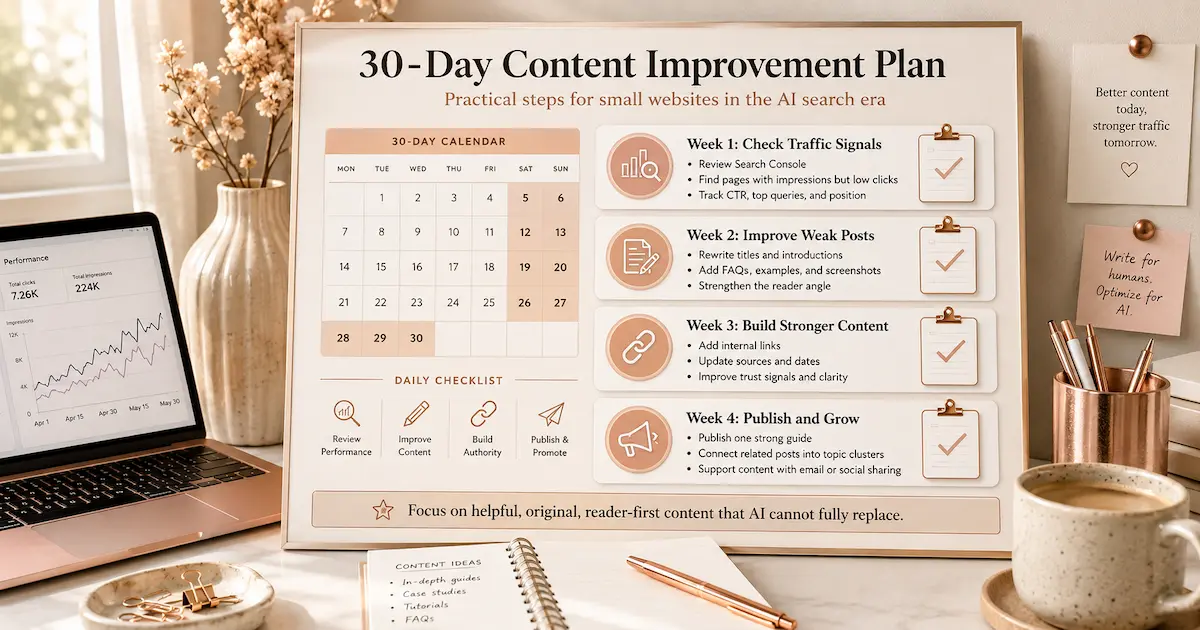
This simple 30-day plan helps small website owners move from worry to action without trying to fix the whole site at once.
- Week 1: Check traffic signals.
- Week 2: Improve weak posts.
- Week 3: Strengthen internal links.
- Week 4: Publish one strong guide.
How AI Tools Can Help Small Websites
AI tools can support small website owners, but they should not replace thinking. Use AI to collect ideas, create outlines, simplify drafts, or find missing questions. Then add human judgment, examples, and accuracy checks.
Free AI tools for small business owners can also help with content planning, email ideas, image prompts, draft organization, and weak page updates.
- Use AI for structure.
- Check facts manually.
- Add personal judgment.
- Rewrite for real readers.
AI can speed up work. However, the final voice should still feel human, clear, and responsible.
What AI Search Means for Monetization
Small websites that depend only on search clicks may need to rethink monetization. AI search can reduce visits for basic topics, so income from ads may become less predictable.
A 2026 research paper on Google AI Overviews and Wikipedia found that AI Overview exposure reduced daily traffic to English Wikipedia articles by around 15%. The research paper on AI Overviews and Wikipedia traffic gives early evidence of how AI summaries can shift attention away from source pages.
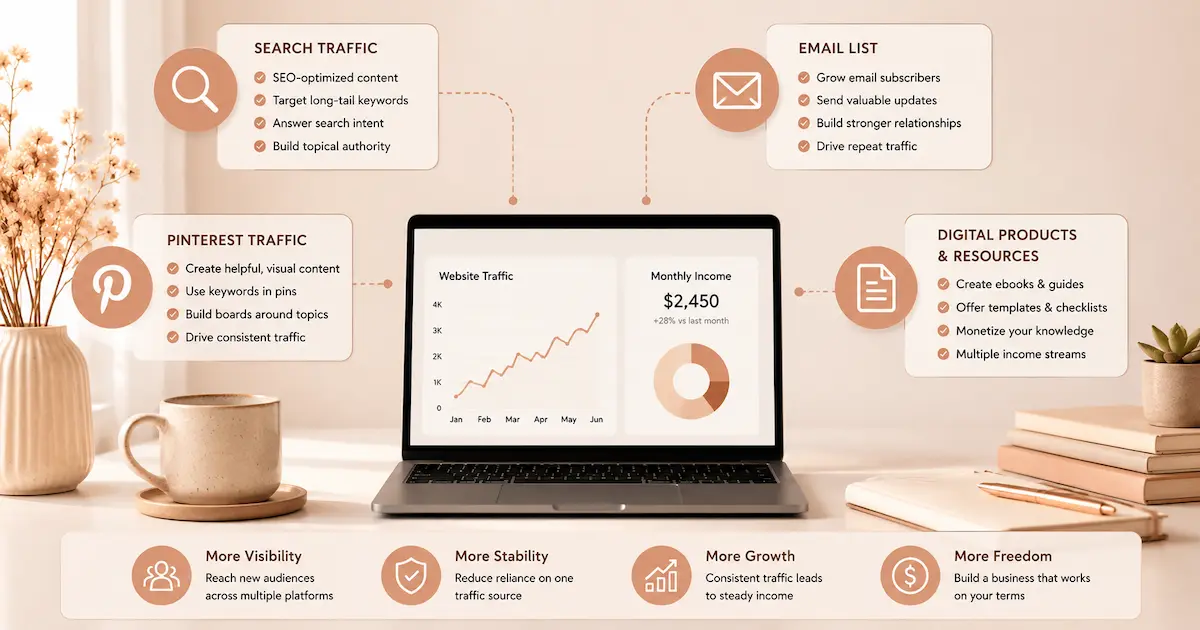
Small websites should build other traffic and income paths.
- Grow an email list.
- Build Pinterest or social traffic.
- Create helpful downloadable resources.
- Add service or affiliate pages carefully.
Search still matters, but it should not be the only source of growth.
Common Mistakes Small Websites Should Avoid
Many small website owners react to AI search with fear. That can lead to rushed content, weak updates, and overuse of AI-written posts.
Random publishing also becomes riskier in 2026. Before writing a new post, small website owners should ask: “What will the reader still need after AI gives a short answer?”
Copying what large SEO websites already publish can also weaken a small site’s voice. A small website needs a sharper reader angle. For example, “AI search and SEO” is broad. “How AI search affects small websites” feels more specific and useful.
Another issue is writing long posts without real value. Length helps only when the article stays clear, helpful, and easy to read.
- Do not copy big-site topics blindly.
- Avoid keyword stuffing.
- Do not publish unverified AI content.
- Avoid weak intros that say nothing new.
Simple Checklist Before Publishing
Before publishing an article in 2026, small website owners should check whether the post gives readers a reason to click beyond the AI summary.
A strong article should answer the main question early, explain the issue clearly, and give practical steps for improving online visibility for small websites. It should also include internal links, reliable external sources, FAQs, and a clear conclusion.
The checklist should feel simple enough to use every time.
- Does the title match the reader’s concern?
- Does the intro explain why the topic matters now?
- Does the article add original value?
- Does each section stay short and easy to read?
This is how small sites can compete with trust, clarity, and usefulness.
The advice in this article should be reviewed again as Google continues updating AI Search features in 2026.
Final Thoughts
AI search will change small website traffic in 2026, but it does not remove the need for helpful websites. It simply raises the standard. Basic answers may get fewer clicks, while practical, honest, reader-focused content can still earn attention.
The safest path is to understand how AI search affects small websites and then respond with better content, stronger trust signals, smarter internal links, and clearer topic clusters. Small websites may not beat large publishers on authority, but they can win through usefulness, personal context, and real guidance.
FAQs
1. What does AI search mean for small websites?
AI search means search engines can show AI-generated answers directly in search results. For small websites, this may reduce clicks for basic questions but increase the need for deeper, more helpful content.
2. Does AI search reduce website traffic?
AI search can reduce clicks for some informational queries. However, the impact depends on the topic, search intent, content quality, and whether readers still need a detailed explanation.
3. Can small websites still rank in 2026?
Yes, small websites can still rank in 2026. They need focused topics, helpful content, clear structure, updated information, and stronger trust signals.
4. What type of content works better in AI search?
Content with personal examples, comparisons, practical steps, expert judgment, updated facts, and real reader value can work better than basic definition-style posts.
5. Should small websites stop writing SEO content?
No, small websites should not stop SEO. They should write SEO content with a reader-first approach instead of relying only on keywords.
6. How can bloggers protect traffic from AI search?
Bloggers can update old posts, build topic clusters, add internal links, improve introductions, answer deeper questions, and grow other traffic sources like email and Pinterest.
7. Are AI Overviews bad for small websites?
AI Overviews can reduce clicks for some queries, but they can also create visibility for useful sources. Small websites need better content depth and clearer value.
8. How often should old posts be updated?
Small website owners should review important posts every few months. Posts with impressions but low clicks should get priority because they already show search interest.
9. Should small websites use AI tools for content?
Yes, but carefully. AI tools can help with outlines, ideas, and structure, but the final article should include human judgment, fact-checking, and genuine reader value.
10. What is the best way to prepare for AI search?
The best way is to create helpful content that AI cannot fully replace. Add examples, clear advice, trustworthy sources, and practical steps that readers can use.